Introduction
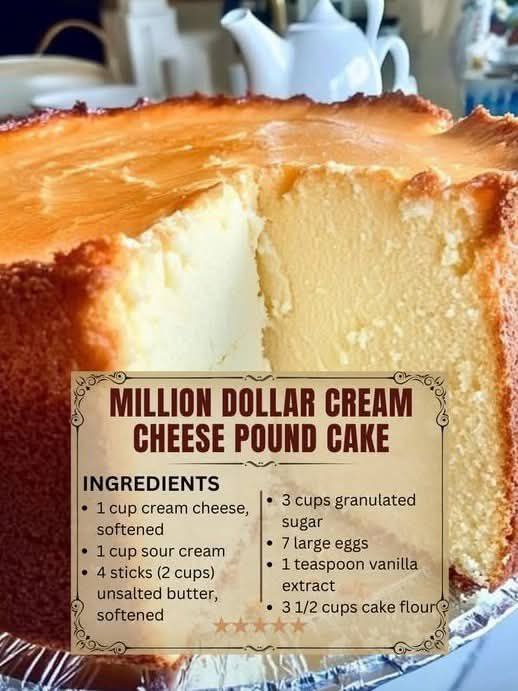
Prepare to elevate your dessert game with the “Million Dollar Cream Cheese Pound Cake,” a recipe that lives up to its opulent name. This isn’t just any pound cake; it’s a culinary masterpiece, celebrated for its unparalleled richness, incredible density, and a moist, tender crumb that practically melts in your mouth. What sets this particular pound cake apart and earns it the “Million Dollar” moniker? The secret lies in the generous inclusion of both cream cheese and sour cream. These two star ingredients work in harmony to infuse the cake with an extraordinary depth of flavor, a subtle tang that beautifully balances the sweetness, and an ethereal tenderness that makes every bite feel truly luxurious. Forget dry, crumbly cakes; this recipe promises a slice of pure, unadulterated decadence.
The Million Dollar Cream Cheese Pound Cake is more than just a dessert; it’s an experience. Perfect for those moments when you want to impress without stress, it’s an ideal showstopper for special occasions, holiday gatherings, or simply as an indulgent treat to brighten an ordinary day. Its classic appeal and foolproof execution make it a must-try for both seasoned bakers and enthusiastic beginners alike. We’re talking about a cake that consistently delivers exceptional results – a golden-brown exterior, a velvety interior, and a flavor profile that will have everyone asking for the recipe. Get ready to embark on a baking journey that will transform your kitchen into a haven of irresistible aromas and your table into a centerpiece of delicious delight.
This comprehensive guide will walk you through every step, ensuring your Million Dollar Cream Cheese Pound Cake turns out perfectly every time. From understanding the role of each ingredient to mastering the creaming method, we’ll cover all the essential techniques. We’ll also share invaluable tips for success, creative serving suggestions to enhance its appeal, and practical advice on storage to keep your cake fresh and delicious. Whether you enjoy it plain, dusted with powdered sugar, or adorned with fresh berries and a luscious sauce, this recipe is designed to deliver a truly unforgettable dessert that will become a beloved staple in your baking repertoire.
Nutritional Information
Per serving (approximate values, based on 16 servings):
- Calories: 550 kcal
- Protein: 7g
- Carbohydrates: 65g
- Fat: 30g
- Fiber: 1g
- Sodium: 250mg
Ingredients
- 1 cup (226g) cream cheese, softened
- 1 cup (240g) sour cream, full-fat
- 4 sticks (2 cups, 452g) unsalted butter, softened
- 3 cups (600g) granulated sugar
- 7 large eggs, at room temperature
- 1 teaspoon pure vanilla extract
- 3 1/2 cups (420g) cake flour, sifted
Instructions
- Prepare Your Pan: Thoroughly grease and flour a 10-inch Bundt pan or a 10-inch tube pan. Ensure every crevice is coated to prevent sticking. You can also use a baking spray with flour. Preheat your oven to 325°F (160°C).
- Cream the Fats and Sugar: In a large mixing bowl, using an electric mixer (stand mixer with paddle attachment or a hand mixer), cream together the softened unsalted butter and softened cream cheese on medium speed until light, fluffy, and well combined, about 3-5 minutes. Gradually add the granulated sugar, about 1/2 cup at a time, beating well after each addition. Continue to beat on medium-high speed for another 5-7 minutes until the mixture is very light in color and airy. This creaming process is crucial for the cake’s texture, incorporating air that will help it rise and achieve its signature lightness within its density.
- Add Eggs and Vanilla: Reduce the mixer speed to low. Add the eggs one at a time, beating well after each addition until fully incorporated. Scrape down the sides of the bowl as needed to ensure everything is evenly mixed. Once all eggs are added, beat in the vanilla extract until just combined. The mixture may look slightly curdled at this stage, but it will smooth out with the addition of flour.
- Alternate Dry and Wet Ingredients: In a separate bowl, whisk together the sifted cake flour. With the mixer on the lowest speed, gradually add the cake flour to the wet ingredients in three additions, alternating with the sour cream in two additions. Begin and end with the flour. For example, add about one-third of the flour, mix until just combined, then add half of the sour cream, mix until just combined, then another third of the flour, the remaining sour cream, and finally the last third of the flour. Mix only until just combined after each addition. Be very careful not to overmix the batter once the flour is added, as this can develop the gluten and result in a tough, dry cake.
- Fill the Pan and Bake: Pour the prepared batter evenly into your greased and floured Bundt or tube pan. Gently tap the pan on the counter a few times to release any large air bubbles. Place the pan in the preheated oven.
- Baking Time: Bake for 1 hour and 15 minutes to 1 hour and 30 minutes, or until a wooden skewer or toothpick inserted into the center of the cake comes out clean. Baking times can vary depending on your oven, so start checking for doneness around the 1 hour and 15-minute mark. The cake should be golden brown on top and firm to the touch.
- Cooling Process: Once baked, remove the cake from the oven and let it cool in the pan on a wire rack for 15-20 minutes. This allows the cake to set and firm up, making it easier to remove without breaking. After 15-20 minutes, carefully invert the cake onto the wire rack to cool completely. Do not rush this step; cooling completely on a wire rack is essential for the cake’s structure and texture.
- Serve and Enjoy: Once completely cooled, slice and serve. This pound cake is delicious plain, dusted with powdered sugar, or paired with fresh berries, a dollop of whipped cream, or your favorite glaze.
Cooking Tips and Variations
Achieving pound cake perfection hinges on a few crucial details. Firstly, room temperature ingredients are non-negotiable. Softened butter, cream cheese, sour cream, and eggs emulsify much better, creating a smooth, homogenous batter that traps air efficiently. This results in a cake with a fine, even crumb and superior texture. If your butter isn’t soft enough, cut it into smaller pieces and let it sit for a bit, or gently microwave in 5-second bursts until pliable. For eggs, place them in a bowl of warm water for 5-10 minutes. Cold ingredients will lead to a lumpy batter and a denser, less desirable cake.
Secondly, do not overmix the batter, especially after adding the flour. Once flour is introduced, gluten begins to develop. Overmixing will activate too much gluten, resulting in a tough, chewy cake rather than the tender crumb you desire. Mix only until the ingredients are just combined and no streaks of flour remain. The goal is to fold the flour in gently rather than beat it vigorously.
Proper pan preparation is paramount for a dense cake like a pound cake. Thoroughly greasing and flouring your Bundt or tube pan ensures easy release and prevents frustrating sticking. Use solid shortening or butter to coat every crevice, then dust with flour, tapping out any excess. For extra insurance, a baking spray that contains flour works wonderfully. If using a dark-colored pan, you might need to reduce the oven temperature by 25°F (15°C) to prevent over-browning.
Speaking of ovens, oven calibration is often overlooked but critical. Ovens can vary significantly, so investing in an inexpensive oven thermometer can save your bakes. Knowing your oven’s true temperature helps prevent under- or over-baking. For pound cakes, a consistent, moderate temperature allows the cake to rise evenly and bake through without drying out.
To confirm doneness, rely on the classic skewer test. Insert a wooden skewer or toothpick into the deepest part of the cake. If it comes out clean, with no wet batter clinging to it, your cake is ready. A few moist crumbs are acceptable, but wet batter means it needs more time. Also, look for visual cues: a golden-brown crust and edges that have slightly pulled away from the pan.
Cooling properly is just as important as baking. Allowing the cake to cool in the pan for 15-20 minutes before inverting it onto a wire rack gives the structure time to set. Attempting to remove it too soon can cause it to break or crumble. Cooling completely on a wire rack prevents condensation and keeps the bottom from becoming soggy. For the best flavor and texture, serve pound cake at room temperature.
Cake flour is preferred over all-purpose flour because its lower protein content yields a finer, more tender crumb. If you don’t have cake flour, you can create a substitute: for every cup of all-purpose flour, remove 2 tablespoons of flour and replace it with 2 tablespoons of cornstarch, then sift it together thoroughly. This mimics the lower protein content of cake flour.
For variations, consider adding citrus zest (lemon, orange, or lime) to the batter for a bright, aromatic lift. A teaspoon or two of almond extract can complement the vanilla beautifully. For a seasonal twist, incorporate warming spices like nutmeg or cardamom. You can also fold in a cup of fresh berries (toss them lightly in flour first to prevent sinking) or chocolate chips for added flavor and texture. For an extra touch of elegance, consider a simple glaze made from powdered sugar and a liquid like milk, citrus juice, or even a liqueur, drizzled over the cooled cake.
Storage and Reheating
Proper storage is key to maintaining the deliciousness and moistness of your Million Dollar Cream Cheese Pound Cake. At room temperature, a whole, uncut pound cake will stay fresh for 3-4 days. It’s best to store it tightly wrapped in plastic wrap or in an airtight container to prevent it from drying out. If the cake is already sliced, place parchment paper between the slices to prevent them from sticking together, then wrap tightly. Avoid storing pound cake in the refrigerator unless it contains a perishable filling or frosting, as refrigeration can dry out the cake and make it dense.
If you need to store the cake for longer, freezing is an excellent option. For best results, allow the cake to cool completely. You can freeze it whole, in halves, or in individual slices. Wrap the cake tightly in at least two layers of plastic wrap, followed by a layer of aluminum foil. This double-wrapping protects against freezer burn. When properly wrapped, pound cake can be stored in the freezer for up to 3 months. To thaw, simply transfer the wrapped cake to the refrigerator overnight, then bring it to room temperature before serving. Individual slices will thaw more quickly at room temperature within a few hours.
Generally, pound cake is best served at room temperature, as this allows its rich flavors and tender texture to shine. Reheating is typically not necessary or recommended for a plain pound cake, as it can alter the texture. However, if you prefer a warm slice, you can gently warm individual slices in the microwave for 10-20 seconds on low power, or in a preheated oven at 250°F (120°C) for 5-10 minutes, being careful not to dry it out. Always ensure the cake is fully thawed before attempting to warm it.
Frequently Asked Questions
Why is my pound cake dry or tough?
A dry or tough pound cake is usually a result of overmixing the batter, especially after adding the flour. Overmixing develops the gluten in the flour, leading to a chewy texture. It can also be caused by baking at too high a temperature or for too long, which dries out the cake. Ensure your ingredients are at room temperature, mix only until just combined, and use an oven thermometer to verify your oven’s accuracy.
Can I use all-purpose flour instead of cake flour?
While cake flour is highly recommended for its lower protein content, which results in a tender, fine crumb, you can substitute it with all-purpose flour in a pinch. To do so, for every cup of all-purpose flour, remove 2 tablespoons of flour and replace it with 2 tablespoons of cornstarch. Sift this mixture thoroughly before adding it to the batter. This substitution helps to mimic the lower protein content of cake flour, but the texture may still be slightly denser than with true cake flour.
How do I prevent my pound cake from sticking to the pan?
Preventing sticking is crucial for a beautiful pound cake. The most effective method is thorough greasing and flouring. Use solid shortening or softened butter to coat every nook and cranny of your Bundt or tube pan. Then, dust generously with all-purpose flour, tapping out any excess. Ensure the entire surface is covered. Alternatively, a baking spray specifically designed with flour works very well. Do not skip this step, especially for intricate Bundt pan designs.
My pound cake cracked on top, what went wrong?
Cracking on top is very common for pound cakes and often indicates that the outside of the cake set and baked faster than the inside. As the inside continues to rise, it pushes through the already set crust, causing it to crack. This is usually not a sign of a ruined cake and often adds to its charming, rustic appearance. To minimize cracking, ensure your oven temperature is accurate (use an oven thermometer) and avoid opening the oven door too frequently during baking, which can cause temperature fluctuations.