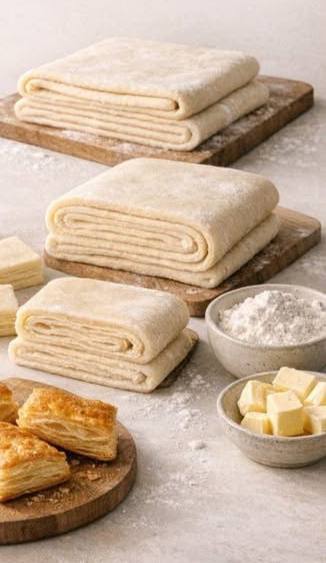
Instructions
- Prepare the Detrempe (Dough Base):
- In a large bowl, whisk together the flour and salt.
- Pour in the ice water and the 2 tablespoons of melted and cooled butter. Mix with a fork or your hands until a shaggy dough forms.
- Turn the dough out onto a lightly floured surface and knead gently for about 5 minutes, until it comes together and is relatively smooth. Do not over knead; you just want it to be cohesive.
- Form the dough into a 6-inch square, wrap it tightly in plastic wrap, and refrigerate for at least 30 minutes, or up to 2 hours. This allows the gluten to relax and the dough to chill.
- Prepare the Beurrage (Butter Block):
- Take the 1 pound of very cold unsalted butter. Place it between two sheets of parchment paper.
- Using a rolling pin, pound the butter until it starts to soften slightly and becomes pliable.
- Roll the butter into an 8-inch square. If the butter gets too soft, refrigerate it for a few minutes. The goal is for it to be cold but flexible, similar in consistency to the dough.
- Wrap the butter block in parchment paper and refrigerate until ready to use.
- Enclose the Butter:
- Lightly flour your work surface. Roll out the chilled detrempe into a 12-inch square.
- Place the chilled butter block diagonally in the center of the dough square, so the corners of the butter point towards the midpoints of the dough’s sides (like a diamond in a square).
- Fold the four corners of the dough over the butter block, bringing them to meet in the center. Pinch the seams firmly to completely enclose the butter, ensuring there are no gaps. This creates a neat package.
- Perform the First Turn (Single Fold):
- Lightly flour your work surface and the top of the dough package.
- Using a rolling pin, gently and evenly roll the dough into a rectangle approximately 18-20 inches long and 8-10 inches wide. Roll from the center outwards, maintaining an even thickness. Be firm but gentle; avoid tearing the dough or pushing the butter through.
- Brush off any excess flour from the surface of the dough.
- Fold the dough into thirds, like a letter: bring one short end into the center, then fold the other short end over the top. You should now have a rectangle with three layers.
- Rotate the dough 90 degrees (so the open seam is on your right). This is important for the next roll.
- Wrap the folded dough tightly in plastic wrap and refrigerate for 30 minutes. This is your first “turn.”
- Perform Subsequent Turns (Repeat 3 more times for a total of 4 turns):
- Remove the dough from the refrigerator. Lightly flour your work surface and the dough again.
- Repeat the rolling and folding process exactly as you did for the first turn: roll into an 18-20 inch by 8-10 inch rectangle, brush off excess flour, fold into thirds, and rotate 90 degrees.
- Wrap and refrigerate for another 30 minutes.
- Repeat this process two more times, for a total of four single turns and four chilling periods. (Some recipes call for 6 turns, but 4-5 turns typically yield excellent results for home baking).
- Final Rest and Storage:
- After the final turn and chill, your puff pastry is ready to use or store.
- For optimal flakiness, give it a final chill of at least 1-2 hours (or even overnight) before rolling out and baking.
- At this point, the dough can be wrapped tightly in plastic wrap and refrigerated for up to 3 days, or frozen for up to 2-3 months. If freezing, thaw overnight in the refrigerator before using.
Cooking Tips and Variations
The secret to successful puff pastry lies in keeping everything cold. Your kitchen, your hands, your ingredients – the colder, the better. If your butter starts to ooze or melt during rolling, stop immediately, wrap the dough, and refrigerate it for 15-20 minutes until it’s firm again. Don’t rush the chilling steps; they are crucial for relaxing the gluten and preventing the butter from incorporating too much into the dough, which would inhibit flakiness. Use a ruler to ensure your butter block and dough are the correct dimensions, and that your folds are even. This precision contributes to uniform layers. When rolling, apply even pressure and roll from the center outwards, avoiding rolling over the edges too much, which can thin them excessively. Lightly flour your surface, but brush off any excess flour before folding to prevent a dry, tough texture. High-quality, high-fat butter (like European-style butter) will yield the best flavor and flakiness. For a richer flavor, you can substitute a portion of the water in the detrempe with milk, but this will also make the dough slightly softer. Some bakers prefer to use bread flour for the detrempe to give it more strength, but all-purpose flour works perfectly well for home baking.
Storage and Reheating
Homemade puff pastry is best used fresh after its final chill, but it stores remarkably well. Once you’ve completed all the turns and the dough has had its final rest, wrap it very tightly in several layers of plastic wrap to prevent it from drying out or absorbing refrigerator odors. It can be stored in the refrigerator for up to 3 days. For longer storage, you can freeze it. Wrap the dough tightly in plastic wrap, then place it in a freezer-safe bag or airtight container. It will keep in the freezer for up to 2-3 months. When you’re ready to use frozen puff pastry, transfer it to the refrigerator to thaw overnight. Do not attempt to thaw it at room temperature, as the butter will melt too quickly. Once thawed, handle it as you would freshly made dough. Baked puff pastry items are best eaten fresh from the oven for maximum crispness. If you have leftover baked items, they can be stored at room temperature in an airtight container for a day or two, or refrigerated for up to 3-4 days. To reheat, place them in a preheated oven at 350°F (175°C) for 5-10 minutes, or until warmed through and crisp. Microwaving is not recommended as it will make the pastry soggy.
Frequently Asked Questions
My butter keeps breaking through the dough when I roll it. What am I doing wrong?
This is a common issue and usually means one of two things: either your butter block was too cold and therefore too brittle, or your dough (detrempe) was not elastic enough. Ensure your butter is cold but pliable, similar in consistency to the dough, before enclosing it. If the dough is tearing, it might need more resting time between turns to relax the gluten. Also, make sure you’re rolling evenly and gently, not pressing too hard in one spot.
How many turns do I really need to do?
Most recipes for puff pastry call for 4 to 6 turns (or “single folds”). Each turn creates more layers. For home baking, 4 single turns (rolling and folding into thirds) will yield excellent results with hundreds of layers and beautiful flakiness. Doing more turns can create even finer layers, but also increases the risk of overworking the dough or melting the butter if not done carefully.
Can I make puff pastry with margarine or a butter substitute?
While technically possible, it is highly recommended to use real, high-quality unsalted butter for traditional puff pastry. Butter substitutes often have different melting points and water content, which can affect the lamination process and the final texture and flavor significantly. The rich, authentic flavor and superior flakiness of puff pastry truly come from butter.
My puff pastry didn’t rise much. Why?
Lack of rise can be due to several factors. The most common reasons include insufficient chilling (butter melted and incorporated into the dough, preventing steam release), not enough turns (not enough layers), or the dough being overworked (gluten became too tough). Ensure all ingredients are cold, you’re following the chilling times, and you’re handling the dough gently to maintain distinct butter layers.